
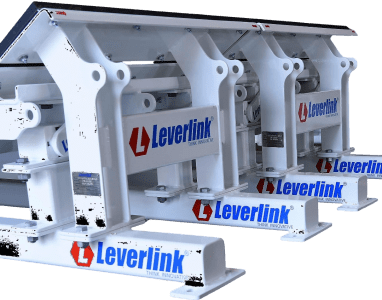
“If you do not understand the problem, you cannot engineer the solution.”
That line sums up why Leverlink’s Dynamic Impact Bed exists in the first place.
In the early 1990s, Leverlink founder Richard Sharp developed the first Dynamic Impact Beds for troughed conveyor belts in Australia. At the time, it wasn’t possible to confirm if it was also the first in the world. Later research suggested it may have been. Either way, the breakthrough was real: a new type of load zone impact bed built for serious production conditions.
Richard also coined the phrase “Dynamic Impact Bed” to describe this new class of conveyor load-zone equipment.
The original goal was to cut maintenance costs where it makes the biggest impact
The concept was built around one clear aim: minimise maintenance cost on high production conveyor load zones, especially:
- Conveyor transfer points
- Load zones beneath crushers
These are the places where belts and structures take repeated punishment. If your load zone design is wrong, you usually see it in one or more of these ways:
- Belt damage and reduced belt life
- Higher clean-up and labour costs
- Ongoing changeouts of consumables
- Unplanned downtime and lost plant availability
In mining and quarrying, downtime is never “just downtime”. It’s lost tonnes, lost hours, and pressure on the whole site.
What Leverlink set out to deliver with Dynamic Impact Beds
From the beginning, Leverlink’s Dynamic Impact Beds were designed to be a long-term solution, not a quick fix. The design targets were ambitious, and they still stand out today:
- Service life: 20 to 30 years
- Extended slide media changeout periods to reduce labour costs
- Warranty: 10 years structural and mechanical (consumables exempt)
- Custom-designed to suit the site’s functional specifications.
- Designed to the highest engineering standard possible, not the lowest cost
- No “off-the-shelf” product. Engineering design is required for the highest possible efficiency.
This is an important point for buyers: when someone tries to sell you an “off-the-shelf” dynamic impact solution, it’s worth asking how it can truly suit your belt width, drop height, tonnage, lump size, and load zone conditions without engineering work.
Impact mounts and shock absorbers are where performance is won or lost
Leverlink learned early that load zones quickly expose weaknesses.
In the early stage, Leverlink used commercially available anti-vibration mounts sourced from suppliers worldwide. But under real conveyor load-zone conditions, deficiencies emerged quickly. The mounts were not designed for the repeated impact forces encountered beneath crushers and high-production transfer points.
That’s when the decision was made to engineer a proprietary IMPACT MOUNT.
Leverlink’s Type RTS, 50/89 Series became a success because it was built for the real duty:
- This is not an “anti-vibration” mount.
- It is a true IMPACT MOUNT.
- Correctly engineered for the application, it is designed not to fail in operation.
- It provides a long service life, over 10 years plus
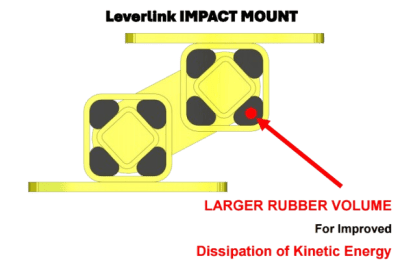
In plain terms, impact mounts are not a small detail. They are the working heart of a Dynamic Impact Bed. If the mount is incorrect for the duty, the system will not perform as intended, regardless of how good the frame looks.
The history behind static impact beds and why they struggled in heavy-duty load zones
Before Dynamic Impact Beds, the market was dominated by Static Impact Beds (often called cradles, tables, or similar names).
A typical static impact bed is built around rubber impact bars. These systems generally include:
- a rigid cradle or frame
- moulded rubber bars to take the load
- a polymer slide media layer vulcanised to the rubber bar to reduce friction
Because the build is simple and manufacturing costs are low, static impact beds are often positioned as a cost-effective alternative to impact idler sets. In practice, they behave more like a belt support system, and that’s where the limitation starts.
Where rubber impact bars start to struggle
Rubber impact bars can perform well in lighter conditions, but heavy-duty load zones impose sustained, high forces that these systems often can’t manage effectively. Static designs are also limited in the amount of kinetic energy they can dissipate, especially when the load is repeated and severe.
This became a major issue on:
- Larger, high-production belts
- Large lump product
- Material free-falling from transfer points
- Direct discharge from large jaw crushers or gyratory crushers (primary and secondary)
- Free-fall heights exceeding 3000mm
The real wear point is the slide media on the rubber bar
With rubber impact bars, service life is closely tied to the thickness of the polymer slide media bonded to the top. Once the slide media wears down, the belt contacts the rubber, friction increases, and the bed’s performance drops quickly.
That’s why it’s not unusual to see usable slide material limited to around 10mm before the belt starts riding on rubber.
There’s another problem: when polymer slide media is vulcanised into rubber, it can distribute load and increase stiffness. That sounds positive, but it can also reduce the rubber’s ability to flex and dissipate kinetic energy, which is exactly what you need in high-impact load zones.
Pros and cons of rubber impact bars (in plain terms)
Pros
- Low initial purchase cost
Cons
- Wear life depends on the amount of slide media available before the belt contacts the rubber.
- Slide media thickness can be limited, which shortens replacement cycles.
- The vulcanised slide layer can stiffen the bar and reduce energy absorption.
- Higher maintenance costs over time, especially in high-drop, high-tonnage load zones
This is why many high-duty sites moved away from basic static systems. The purchase price may appear attractive at first, but the labour, downtime, and replacement cycle can make it expensive over time.
Copies and look-alikes today, and why cheaper can cost more
One of the largest industries worldwide is copying other people’s products and concepts. That can happen through web searching, site visits, and other sources.
The copier’s goal is usually the same, produce a competitive product at a lower price. The risk is that the buyer is not told about the trade-offs, such as:
- Reduced engineering standards
- Higher maintenance costs down the track
- Shorter service life
- Weaker warranty support
A common warning sign is off-the-shelf anti-vibration mounts
In Dynamic Impact Beds, the impact mounts are critical. It appears that many suppliers still use low-cost, commercially available anti-vibration mounts. In load zone impact duty, this can lead to failures and repeated replacement cycles.
Due to high failure rates in real-world applications, Leverlink developed proprietary TYPE RTS Impact Mounts for its Dynamic Impact Beds.
Leverlink today, and where the experience shows

After 30 years, Leverlink remains the largest manufacturer of Dynamic Impact Beds for conveyor load zones in Australia and exports to other countries.
Leverlink specialises in large belts and high tonnage, typically 1200mm to 2500mm wide.
Key points our clients care about:
- Leverlink engineers solutions where others will not go
- 10-year mechanical and structural warranty is standard (consumables exempt)
- Leverlink does not manufacture static impact beds.
Ready to reduce belt damage and downtime?
If your load zone is chewing through belts, bars, or labour hours, let’s talk. Share your belt width, drop height, tonnage, lump size, and layout constraints, and our team will review your load zone and recommend a Dynamic Impact Bed engineered to suit your site.
Call 07 3737 2400 or contact us to get started.


